


Why Does This Keep Happening? The Murdaugh Retrial and a Pattern Worth Noticing
A new judge has been assigned to the Murdaugh retrial, and within hours it became one more story about the appearance of a problem rather than the substance of the case. Taken alone, it is minor. Taken together with everything else, it raises a harder question: why does South Carolina's justice system keep handing its critics something to write about in the one case where it can least afford to?
On June 8, the South Carolina Supreme Court assigned Judge Debra McCaslin to preside over the Murdaugh retrial. Within hours, reporters had uncovered that McCaslin, early in her career, had rented office space from Dick Harpootlian and had named him as a professional mentor during her 2019 confirmation hearings. Harpootlian has been Alex Murdaugh's high-profile lead defense attorney throughout the case.
This does not constitute grounds for recusal or indicate that Judge McCaslin is in any way compromised. By all accounts, she is an outstanding judge. I have appeared before her and know her to be fair and capable. And being from the Columbia area, it is no surprise she is familiar with Dick Harpootlian. Most attorneys in Columbia are.
However, this is just one more story that raises unnecessary questions. One more moment where South Carolina's handling of its most scrutinized case has produced a headline about the appearance of a problem rather than the substance of the trial. After the Becky Hill debacle, where the South Carolina justice system looked, at best, unprepared for a case of this profile, this latest appointment makes it start to look like a pattern.
The Pattern
Consider the sequence.
The first trial ended in a reversed conviction because the clerk of court tampered with the jury and then monetized the trial through a book. That was a genuine institutional failure, and the Supreme Court was right to reverse.
It is worth asking why that failure happened where it did. The Murdaugh trial was held in Colleton County, a rural county of roughly 38,000 people. This was likely the most heavily covered trial in the state's history, with media from around the world descending on a small courthouse in Walterboro. A county that size, with the resources and staff it has, was being asked to manage something it had never seen and was never built to handle. That does not excuse what the clerk did. But a case of this magnitude landing in a venue of that size created exactly the kind of strain in which things go wrong. Someone might have anticipated that.
The same opinion that reversed the conviction also criticized the prosecution for going too far, too long, and too deeply into financial crimes evidence that the trial court had admitted. Whatever you think of that critique, it added another layer of public second-guessing to an already battered proceeding.
The venue for the retrial remains unsettled, with the defense already signaling that a fair jury cannot be seated in the county where the case originated.
And now an appointment that, within hours, generated a fresh round of coverage about whether the presiding judge is too close to defense counsel.
Take any one of these in isolation, and it is explainable, even minor. The venue fight is routine. The appointment raises no real conflict. But step back and look at them together, and a question becomes hard to avoid: why does the system keep handing its critics something to write about in the one case where it can least afford to?
Avoidable Is the Operative Word
Here is what ties these moments together. To varying degrees, they were all foreseeable.
The Becky Hill catastrophe was the most serious, and the hardest to have prevented in the moment. But even there, the decision to try a case of this profile in a county of that size, which had never been tested with a case of that caliber, was a choice, and a foreseeable source of strain.
The appointment is the clearest example. It was entirely avoidable. A single sentence acknowledging the prior relationship, on the record, and there would be no story at all. The relationship would be a footnote rather than a headline.
That is the frustrating part. The South Carolina state system keeps creating unnecessary problems in a case that has already absorbed more scrutiny of its flaws than any proceeding in modern South Carolina history. This appearance undermines both belief in and perception of justice in South Carolina on a national stage. When the system should be setting an example, it is underwhelming. That is truly unfortunate because the victims in the case and all those affected by it deserve more.
The Question I Cannot Answer
It is possible that this is simply a run of bad luck. The Murdaugh case is extraordinarily hard. It is long, complex, saturated with media attention, and it involves a defendant whose family has been woven into the fabric of the local legal system for generations. A case like that will surface complications a routine prosecution never would, and maybe these issues are routine. Under that view, none of this reflects a deeper problem. It is just the friction of an unprecedented case grinding through the system.
The other possibility is harder to dismiss with each new development. It is that a system which keeps producing these moments, in its most visible case, may be telling us something about how it operates day to day, in the thousands of cases that never make the news. If the appearance of a problem keeps arising where everyone is watching, it is fair to wonder what happens where no one is.
I do not know which it is. I am not sure anyone does yet. But three years into this case, South Carolina's courts are still being tested by it, and the questions have not stopped coming. At some point, a pattern stops being a coincidence and starts being a characteristic. We are not necessarily there yet. But we are close enough that the question deserves to be asked out loud.
Nathan S. Williams is a South Carolina federal criminal defense attorney and former Assistant U.S. Attorney who served as Criminal Chief for the District of South Carolina. He prosecuted United States v. Dylann Roof, the first federal capital hate crime case in American history, and United States v. Brandon Council, one of only five federal death verdicts since 2015.

What It Would Take for Prosecutors to Win a Death Verdict in the Murdaugh Retrial
South Carolina Attorney General Alan Wilson says the death penalty is on the table in the Murdaugh retrial. As someone who has prosecuted two federal death penalty cases, I have a specific view on whether the state can actually win one — and what it would take to get there.
South Carolina Attorney General Alan Wilson didn't waste any time. Two days after the SC Supreme Court unanimously overturned Alex Murdaugh's murder convictions, Wilson made clear that the state's reset is complete: "In light of the Supreme Court's decision, we're back to square one on this case, and that means all our legal options are on the table, including the death penalty."
That statement raises a more specific question than it answers. Not whether the state can seek the death penalty, but whether it can actually win one. The death penalty was not on the table in the first trial. Murdaugh was tried, convicted, and sentenced to life without parole, the maximum the state chose to pursue at the time. At first glance, escalating to death looks like a reach. There were jurors in the first trial who struggled with guilt, the excused so-called "egg juror" being the most notable example. And persuading that same pool of jurors to go further and impose death is a heavier lift still. A case involving a wife and son killed by their husband and father to cover up years of financial crimes is exactly the kind of case death penalty law was designed for. Anyone who committed these crimes is an outstanding candidate for the death penalty. Showing Murdaugh was the one who committed them, with the degree of certainty that jurors require to impose the most significant penalty available, will be the real challenge for prosecutors.
The Legal Foundation Exists
Wilson is legally correct that the retrial resets everything. When a conviction is vacated and a new trial ordered, the state is not bound by the charging decisions of the prior prosecution. Double jeopardy does not apply to sentencing enhancements in a retrial context. The state can seek a more severe punishment than it did the first time around, on the same facts.
The factual case for death penalty eligibility also exists. South Carolina law permits capital punishment for murder with certain statutory aggravating circumstances. Practically speaking, prosecutors need to show that this case is worse than the average murder, the worst of the worst, and that the circumstances compel a more significant punishment. Multiple victims accomplishes that. The family relationship, a wife and a son, adds the kind of aggravating weight that distinguishes this case from others. And the financial motive, which was so heavily criticized in the Supreme Court’s reversal of the first conviction, would be far more readily admissible in a penalty phase, and far more powerful there. It adds up to a husband and father who allegedly killed his own family to cover up years of theft. That level of premeditation and callousness would justify a death sentence, provided the state can show with sufficient certainty that Murdaugh was the one pulling the trigger.
The Strategy Factor
It would be wholly inappropriate to use the death penalty as a leverage tool, and the state has shown no indication that it is doing so. If the state gives notice of intent to seek death, it will be fully litigated. There will be no pulling it back without significant consequences to the prosecution’s credibility. And leverage is largely beside the point here anyway. Murdaugh’s attorneys have been clear: he will not plead guilty under any circumstances. He is already serving 27 years on state financial crimes charges and 40 years on federal charges. He has little incentive to enter into any agreement and will likely not be deterred by a potential death sentence.
It is also worth acknowledging the broader context. Wilson is widely expected to run for governor of South Carolina. A high-profile murder retrial involving the state’s most notorious defendant is precisely the kind of moment that defines a law enforcement career. Seeking the death penalty sends a clear signal to SC voters about how Wilson approaches the state’s most consequential cases. That doesn’t make it the wrong decision. I believe the facts of this case, if proven, would support a death sentence. But a complete analysis has to account for the full picture, which includes the political environment in which this decision was made.
The Core Problem: Identity
Here is where the prosecution faces its most significant obstacle.
The state is facing a genuine identification problem, at least when seeking the death penalty. In the first trial, the entire defense argument was that Murdaugh did not commit the crime. They did not argue so much that the crime was insufficiently horrible to justify a severe sentence. In fact, the defense leaned into the horror of it: the acts were so unimaginable that a husband and father could not have done such a thing, and therefore it must have been someone else. That argument doesn’t go away in a capital case.
Jurors who can fairly apply the death penalty are almost universally concerned about one thing above all else: residual doubt, and in this case, the degree of certainty the defendant actually did it. They carry in the back of their minds the irreversibility of an execution, that there is no remedy if new evidence emerges or if the wrong person was convicted. Capital defense lawyers consistently remind jurors of exactly this. The majority of death penalty cases involve overwhelming evidence of guilt. Video evidence, eyewitnesses, confessions, defendants who bragged about their crimes, or some combination if not all of these. The Murdaugh case does not have that profile.
The dilemma for the prosecution is real: the facts surrounding the crime, if proven, justify the death penalty. But the evidence of identity makes a death verdict difficult. Based on the evidence presented at the first trial, I believe getting a death sentence would be an uphill climb based on the relatively thin evidence of identity. There is enough to prove guilt beyond a reasonable doubt. But it is likely not enough to give the jury the needed confidence to impose death.
A Death Penalty Trial Looks Completely Different
Beyond the identity problem, seeking death fundamentally changes the nature of the trial itself. Death-qualifying the jury, that is, eliminating jurors who could never impose the death penalty regardless of the evidence, should, in theory, produce a jury more favorable to the state on the guilt question. But it also produces a jury with a defined and demanding set of expectations about what the evidence must show before they will sign a death verdict, expectations that may be difficult to meet in a case built primarily on circumstantial identification.
As well, the prosecution’s decision not to seek death in the first trial may become a defense argument. Dick Harpootlian and Jim Griffin are accomplished lawyers. They will find ways to suggest the state is overreaching and hoping the jury reaches a guilty verdict as a compromise. That they are seeking death to make a guilty verdict seem less significant and therefore more likely to occur, in effect reducing the risk of an outright acquittal. In front of a jury that may be aware of a prior trial where the death penalty was not sought, and the evidence has not changed, seeking the death penalty could look manipulative, and that argument could land.
What It Would Actually Take
If no significantly new evidence of identification has emerged since the first trial, I believe there is inadequate evidence of identification to obtain a death sentence. There will simply be too much residual doubt about identity for jurors to be comfortable signing a death verdict. That is not a criticism of the prosecution, they have the facts they have. It is a reflection of how capital juries actually deliberate.
However, this is a close call and a legitimate prosecutorial consideration, not just posturing by the attorney general. The facts of this case are genuinely horrific and distinguish it from most murder prosecutions. A husband and father who killed his family to conceal financial crimes is exactly the kind of case death penalty law was designed for. If the state has developed stronger evidence of identification since the first trial, something that moves the needle beyond where it was in 2023, a death verdict becomes a real possibility.
That is the question prosecutors need to be asking themselves right now. Not whether the facts justify seeking death. They do. But whether the evidence of identity is strong enough to actually win it.
Nathan S. Williams is a South Carolina federal criminal defense attorney and former Assistant U.S. Attorney who served as Criminal Chief for the District of South Carolina. He prosecuted United States v. Dylann Roof, the first federal capital hate crime case in American history, and United States v. Brandon Council, one of only five federal death verdicts since 2015.
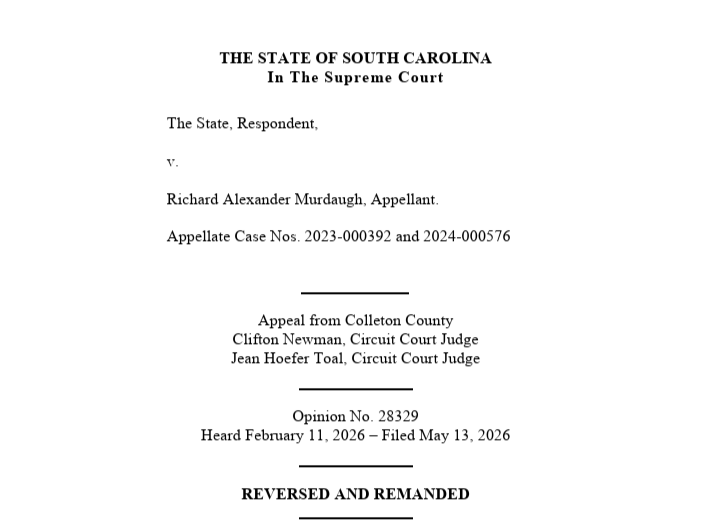
When the Supreme Court Talks to Prosecutors
The SC Supreme Court's Murdaugh ruling is being read as a jury tampering case. It's also something else — a direct critique of the prosecution's trial strategy that breaks from normal appellate practice and raises a question most commentators have missed: is it fair to criticize prosecutors for presenting evidence the trial judge expressly approved?